


[ad_1]
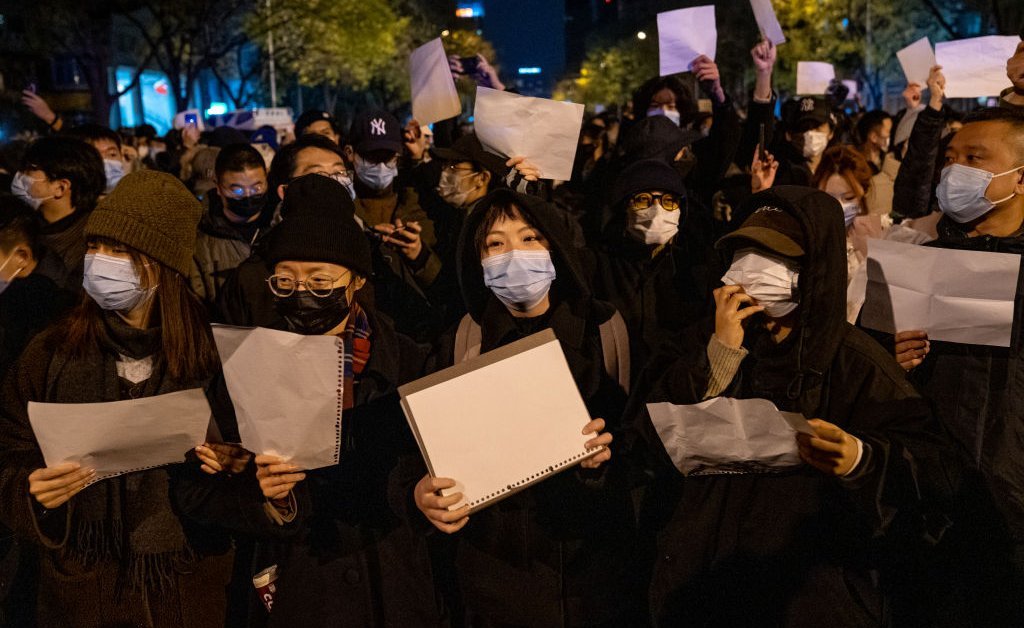
Protests in a number of Chinese language cities in opposition to the Chinese language authorities’s robust COVID-19 insurance policies mirror the rising sentiment of individuals all over the world. We’re fed up with the pandemic and the numerous methods the SARS-CoV-2 virus has modified our lives ceaselessly. However the demonstrations in China additionally mirror a extra particular, native frustration at a technique to battle the virus that has lengthy since left behind each different nation on the planet.
China’s zero-COVID technique is an extension of the drastic measures taken not solely on this nation however in different nations all over the world, together with the US, within the early days of the pandemic to attempt to eliminate the virus as rapidly as potential suppress. That made sense at first when individuals had no immunity to the virus and there have been no vaccines or therapies to battle it. In truth, establishing lockdowns and stopping individuals from mixing are among the many public well being pillars of combating an infectious illness. “Using quarantine, isolation, and testing are all core public well being methods that we use in all kinds of outbreaks,” says Caitlin Rivers, an epidemiologist on the Johns Hopkins Heart for Well being Safety. “They usually stay viable. However they do not all the time violate fundamental freedoms and rights, as now we have seen in China. On this case, they’ve clearly develop into very giant.”
China’s technique has been to check individuals commonly earlier than they go away their properties or enter public amenities, and if somebody checks constructive, instantly quarantine the power the place the case arose, even when meaning individuals being prevented from returning residence from work or a day journey to Disneyland. From there, individuals who check constructive are taken to isolation amenities, the place they continue to be till they current unfavourable checks earlier than being allowed to return residence.
However whereas monitoring the virus on this means can restrict its unfold, such stalking can solely go to this point. Finally, the virus escapes and new infections are seeded. Within the case of SARS-CoV-2, this chances are elevated by the truth that the virus additionally lives in animal hosts, the place it continues to thrive and mutate, ready for alternatives to contaminate susceptible human hosts with low ranges of immunity to it. “It is onerous to think about how a zero-COVID coverage would eradicate this virus,” says Dr. Ian Lipkin, director of the Heart for An infection and Immunity on the Columbia Mailman Faculty of Public Well being. “Even in the event you exclude all people from the function as hosts, there are nonetheless animal reservoirs that may carry the virus and reintroduce it into the human inhabitants.”
Whereas different nations, together with Australia, the UK and the US, carried out quarantine techniques much like China’s within the early days of the pandemic, well being officers there all the time conceded that it might be a short lived answer till the inhabitants’s immunity was boosted may very well be publicity to pure infections and in the end by vaccines.
For China, nonetheless, the technique was rigid and lacked a clearly outlined exit technique – largely due to its shut ties to the authority and status of the ruling Chinese language Communist Celebration. “Politically, the response to the pandemic was framed as a contest between two political techniques, and Xi Jinping used China’s early success to reveal the prevalence of the Chinese language political system,” says Yanzhong Huang, senior fellow on international well being on the Council on International Relations. and Professor of World Governance and Well being Points in Asia at Seton Corridor College. “In concept, they might declare that if they’re able to keep low ranges of an infection after different nations transfer away from zero-COVID insurance policies, they’re the one winners within the battle. So the excessive political stakes additionally helped China keep this coverage.”
In the meantime, for the remainder of the world, as efficient vaccines grew to become accessible in late 2020, a zero-tolerance technique rapidly grew to become out of date. Because the inhabitants’s safety from the virus will increase by vaccination, there is no such thing as a longer a must lock up contaminated individuals and attempt to lock down giant areas. That is the strategy Australia took following a zero-COVID coverage early within the pandemic. However, Rivers says, the distinction was that Australia capped the strict lockdowns, promising to carry them when 80% of the inhabitants was vaccinated and due to this fact higher protected in opposition to critical illnesses. “There needs to be an exit technique,” she says. “Australia clearly outlined this technique to maintain the general public on board and understanding what the best way ahead was. It was additionally essential to make sure the nation was not caught in an untenable place.”
China might discover itself in such a state of affairs, and not using a clearly articulated finish to its present insurance policies.
The threats to international public well being posed by China’s insurance policies
Whereas holding individuals remoted provides the virus fewer alternatives to unfold and infect regionally, in a world pandemic that might not be probably the most fascinating finish outcome. People who find themselves under-vaccinated or who haven’t had a lot publicity to pure an infection with the virus don’t generate sturdy T-cell responses, which scientists say are essential for longer-lasting safety in opposition to extreme COVID-19 illness. A lot of the remainder of the world constructed up these T-cell defenses on account of a mixture of vaccination, booster and publicity to and an infection with COVID-19. China’s individuals should be within the early phases of build up such a safety. “Principally, they’ve a inhabitants that’s inadequately protected by both earlier an infection or vaccination and who at the moment are prone to spreading the virus,” says Lipkin.
Additionally contributing to that is the truth that research present that the vaccines taken by the vast majority of the Chinese language inhabitants, that are manufactured within the nation by two native firms, Sinovac and Sinopharm, don’t provide as a lot safety in opposition to an infection or critical illnesses as these in China China-made USA and Europe. These vaccines use inactivated types of the SARS-CoV-2 virus to stimulate the immune system, whereas different approaches have used new mRNA or viral vector applied sciences. Which means whereas China’s inhabitants could also be vaccinated, it might not be as protected because it may very well be. Certainly, Lipkin says that if China used vaccines like Pfizer-BioNTech and Moderna’s mRNA syringe or AstraZeneca’s viral vector vaccines as booster photographs, it may enhance the safety began by the inactivated viral vaccines that the Chinese language are utilizing have used to this point. Chinese language scientists have been engaged on these different kinds of vaccines, together with mRNA photographs, however well being management has not but endorsed these for widespread use within the nation.
Then there’s the human and financial toll of quarantining individuals, slicing them off from their social, skilled and cultural connections and disrupting them. The outcome has been that pent-up frustrations have erupted over the previous few weeks in protests not solely in opposition to restrictive COVID-19 insurance policies however in opposition to your complete communist system in a panoramic and fast-spreading motion. “I feel the social gathering was stunned to see protests in a number of cities,” says Huang.
Tips on how to take the subsequent step ahead
Well being specialists agree that the highway to zero-COVID is to speed up the vaccination of the inhabitants, which the Chinese language management has been attempting to do in latest weeks. However social gathering officers are scuffling with a self-inflicted downside, with many older members of the inhabitants not being vaccinated as a result of they do not really feel the urgency in a rustic the place instances have been comparatively low given the strict lockdowns. In a report launched Nov. 28, state well being officers in China stated 65.8% of individuals over the age of 80 had obtained a booster dose. That is up from the 40% reported mid-month – however nonetheless means too low.
Even when extra persons are boosted, given the diminishing safety these vaccines present, particularly in opposition to newer Omicron variants, such boosters might not be sufficient to spice up inhabitants immunity to ranges that will part out the zero-COVID virus. coverage would justify. So long as the virus is ready to make extra copies of itself, it can proceed to evolve and create new mutations, a few of which may develop into variants that unfold sooner or trigger extra extreme illness. The roulette wheel of viral mutations retains turning, and the most effective protection to gradual it down is immunity — both by vaccinations or bouts of an infection.
“China has a inhabitants with very low infection-acquired immunity. And vaccine-acquired immunity hasn’t held up properly in opposition to new variants over time,” says Rivers. “So we anticipate a inhabitants that’s broadly susceptible. And these are conditions for big waves of an infection. From a public well being perspective, I might anticipate widespread vaccination and empowerment of older individuals. However that is as a lot a political concern as it’s a public well being concern.”
Extra must-reads from TIME
[ad_2]


Discussion about this post