


[ad_1]
MHer father is within the Selkoe Laboratory at Brigham and Girls’s Hospital. And he is at work.
This may occasionally appear unlikely as my father handed away from Alzheimer’s illness in March 2022. However since his loss of life, my father has helped pioneer the validation of efficient remedies that had been unavailable to him. Analysis performed on his mind tissue helps scientists perceive how the not too long ago FDA-approved lecanemab can (hopefully) be improved and an much more efficient therapy for Alzheimer’s illness developed.
Through the years my mom, sisters and I’ve taken care of my father, we’ve targeted on overcoming instant obstacles. We stood subsequent to him at social gatherings so we might step in when he wanted assist to have a dialog. We researched monitoring gadgets to guard him in case he strays. We realized to know him when he was speechless for weeks. Medicines helped handle the signs however didn’t sluggish or reverse the illness. As my father’s Alzheimer’s illness progressed, I envisioned two ascending strains: one the development of my father’s illness and one the curve of scientific innovation; My father’s sickness is at all times racing quicker than scientists’ skill to know and cease it.
Proceed studying: How you can be there for a partner with Alzheimer’s
Within the 1990s, Dennis Selkoe and different main scientists hypothesized that Alzheimer’s illness is triggered by the buildup of a clumped protein – amyloid – within the mind and that eradicating amyloid might stop cognitive decline. Whereas this idea, referred to as the amyloid speculation, was the premise for a lot of Alzheimer’s analysis, early makes an attempt to assault the amyloid did not sluggish reminiscence loss, maybe as a result of they did not take away a lot amyloid.
Sadly, the 2021 FDA approval of Aduhelm, the primary drug to result in decrease ranges of amyloid within the brains of sufferers, has been marred by controversy. Poor decision-making by the producer resulted in two trials being terminated prematurely. Incomplete and conflicting knowledge, in addition to excessive charges of transient mind swelling, left critical questions on Aduhelm’s effectiveness, compounded by a much-criticized FDA approval course of.
Regardless, Aduhelm was not appropriate for my father, who on the time of his admission had progressed to superior Alzheimer’s illness, past the purpose the place scientists consider amyloid elimination could possibly be efficient.
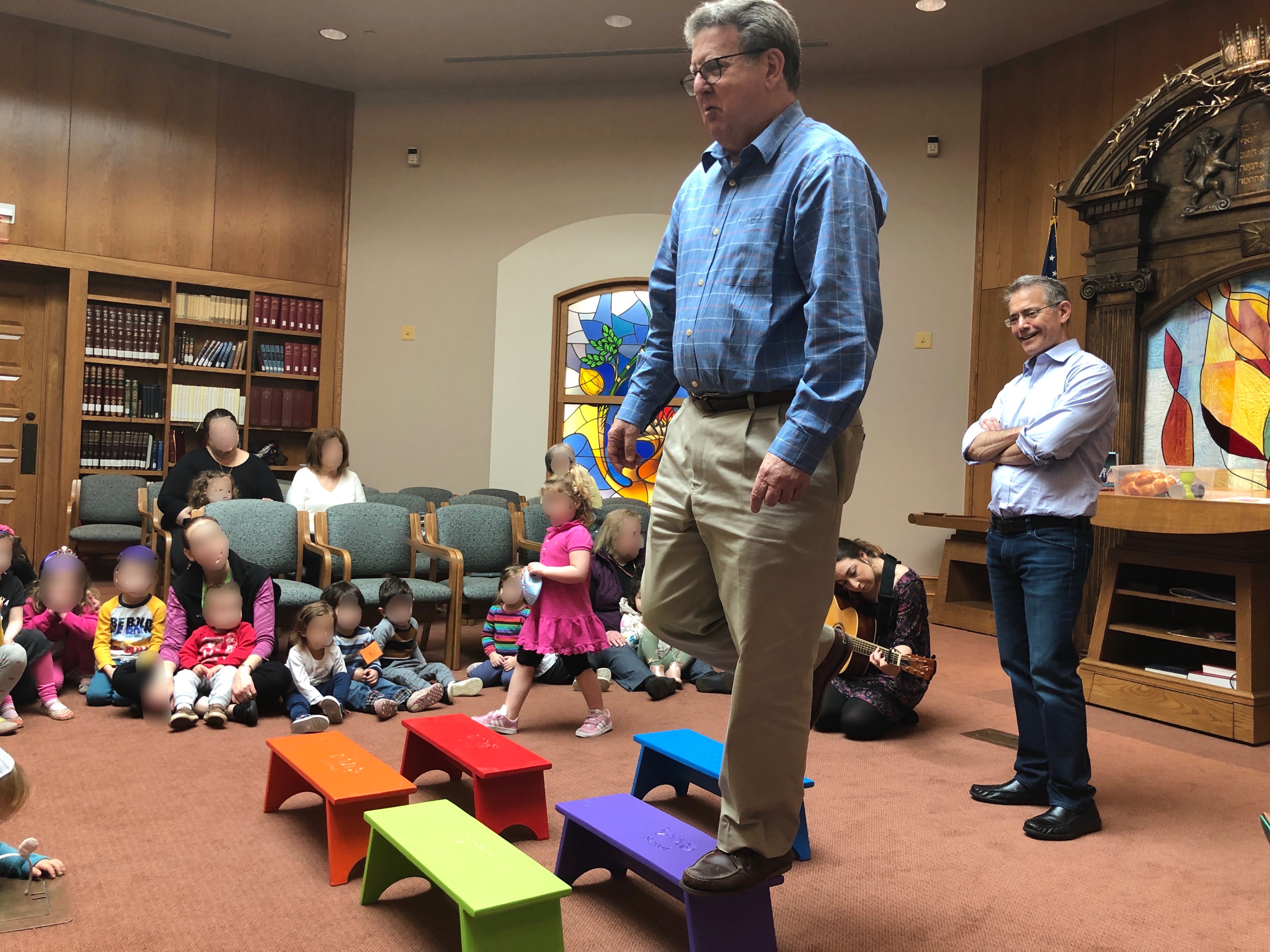
Earlier than he obtained sick, my father, the primary caregiver, was by no means annoyed. When he noticed an issue, he targeted on an answer. After I was a child he designed an ideal step stool. The legs, strut and seat are completely related to provide you: get on, you possibly can’t tip and fall. He balanced like a flamingo on one foot on the sting of the seat, reveling in how the stool distributed the load of his six-foot body in inconceivable methods.
Courtesy of Rebecca Leventhal
Within the early years of his sickness he made virtually 100 stools for kids he knew.
In caring for my father, we tried to supply him what he supplied us: a strong basis to face on. When he went for a stroll, I adopted quietly behind. When he determined to swim, I’d bounce within the pool absolutely clothed and luxuriate in watching him benefit from the really feel of the nice and cozy water and the splash of his grandchildren.
As his Alzheimer’s illness progressed, we struggled to offer him with ample help. He grew annoyed, unable to work round his new limitations. We discovered him fumbling round with a damaged hinge, understanding it wanted to be mounted however unable to discover a resolution. At that second I felt a pointy pang in my chest – ache and delight; I beloved that he was nonetheless an issue solver and I wished to help him in fixing this explicit downside.
We had three weeks from the information that my father was dying to his loss of life. In these blurry days when my mom, sisters, and I went from pondering he would dwell for a number of years to realizing he would not dwell lengthy, we determined to donate his mind to Alzheimer’s analysis.
In that first week, the thought of donating my father’s mind got here to me. I referred to as my mom and requested what she thought of it. She appeared delay by the thought and talked about the Jewish precept that one ought to bury the physique entire.
Not understanding something about mind donation, I googled “mind donation” and noticed an inventory of locations that settle for mind tissue. I envisioned my father’s unaccompanied mind being shipped throughout the nation in a padded envelope to a lab I did not know. I felt like we had been letting him down. I dropped the topic.
A number of weeks later, one among my sisters referred to as me and requested once more, “Ought to we take into consideration donating Dad’s mind?”
She emailed Seth Gale, my father’s neurologist, to ask if we might be taught extra in regards to the course of. Shortly after Seth recognized him, my dad had made a stool for Seth’s children. The following morning, three days earlier than my father died, my sisters, my mom, Seth and I sped off.
In the course of the years that my father was sick, nobody prompt mind donation. I can think about that it’s extremely troublesome for a physician to deal with the topic. My sisters and I do not know why we thought of it, besides perhaps that the act of seeing my father die made us ask ourselves, “Is there one thing we must be doing?”
Seth defined the method with out assuming we’d in the end go for it. He repeatedly instructed us, “You do not have to do that.”
Seth mentioned if we made the donation, my father’s mind would keep at Brigham and Girls’s Hospital the place he can be handled. I spotted we’d know the place his mind was and who had it. My mom, who had thought-about burying his physique utterly, referred to as me afterwards and mentioned, “If I had a tumor, I’d take away it and someday I’d be buried with out it. It is no completely different.” After Seth put the zoom down, my mother, sisters, and I took a minute to talk. Every of us knew we wished the chance to assist individuals. The reply was clear.
I requested Seth to place me by way of to the mind donation group. Andrew Stern, doctor and scientist at Selkoe Lab, referred to as me to speak about logistics.
Two weeks earlier I had leaned my head towards my father and instructed him, “Father, you might be dying. Nevertheless it’s OK. We’re right here. We’re all nice and we’ll care for one another.” Now I sat down on my father’s mattress, put my head on his and mentioned, “Father, you care about individuals. You donate your mind so this does not occur to different households. ”
Three days later, at my father’s bedside, I texted Andrew to let him know that my father had handed away. Andrew referred to as the funeral residence and made positive the hospital group was prepared. That night, after I emailed my father’s obituary to household and buddies, I Bcced Andrew. If he had my father’s mind, he would know my father.
I instructed my father he would assist, however the assist felt summary. I had no thought what the analysis would appear like or how briskly his mind would work.
On November 29, 2022, on the 15th Scientific Trials on Alzheimer’s Illness (CTAD), Eisai offered its giant randomized section III managed trial of lecanemab, an anti-amyloid drug. The outcomes confirmed that lecanemab slowed the decline in cognitive operate, useful capability and high quality of life in sufferers with early-stage Alzheimer’s in comparison with a placebo. Like Aduhelm, however not like earlier medicine, lecanemab cleared amyloid from sufferers’ brains. Importantly, not like Aduhelm, lecanemab accomplished its scientific trials as meant, displaying a lot much less swelling or bleeding. These outcomes purpose to substantiate that eradicating amyloid helps stop cognitive decline. On January 6, 2023, lecanemab (now branded Leqembi) was accepted by the FDA. Lecanemab might symbolize the primary change in the usual of look after early-stage Alzheimer’s sufferers in practically 20 years. (The present Medicare coverage makes entry to lecanemab tougher for many sufferers, though hopefully that can change quickly.) The mechanism underlying lecanemab, not like all remedies accessible to my father, has the potential to cease the illness. This can be a big leap for Alzheimer’s analysis.
The research reveals that lecanemab can work, however questions stay how it really works — specifically, scientists are nonetheless studying the precise dimension and form of the amyloid that’s so damaging to the mind. On the identical convention, Andrew Stern and Dennis Selkoe offered the primary pictures that illustrate intimately – all the way down to the only atom – precisely the place lecanemab sticks to within the human mind, and maybe how scientists can enhance on this advance.
I do know these photos nicely. They’re pictures of lecanemab sure to amyloid fibrils, tiny rod-shaped clumps of protein, from my father’s mind.
In September 2022, Dennis and Andrew invited my household to the Selkoe Laboratory. Dennis and Andrew walked us by way of the scientific understanding of Alzheimer’s, the amyloid speculation, after which by way of pictures displaying lecanemab binding to amyloid from my father’s mind tissue. My father is now gasoline for the curve of scientific innovation.
When Andrew and Dennis detailed their analysis, they referred to my father by title, like a colleague.
My father, who died of Alzheimer’s and had no disease-modifying medicine accessible, confirmed in Dennis and Andrew’s palms how Alzheimer’s might probably be stopped. Working with Dennis and Andrew, he solves his most irritating downside. He will get the prospect to construct the inspiration for others that he did not have. There, within the Selkoe lab, taking a look at pictures of lecanemab sure to my father’s mind tissue, I might see my father balancing like a flamingo on the sting of a step stool.
Extra must-reads from TIME
[ad_2]


Discussion about this post