


[ad_1]
The United States is a surprisingly harmful place to get pregnant. The US maternal mortality fee — practically 24 deaths per 100,000 reside births in 2020 — is much larger than in comparable developed nations, and analysis exhibits it has been getting worse, not higher, in recent times. Maternal mortality charges are notably excessive amongst black girls, with 55 deaths per 100,000 births in comparison with 19 deaths per 100,000 births for white girls.
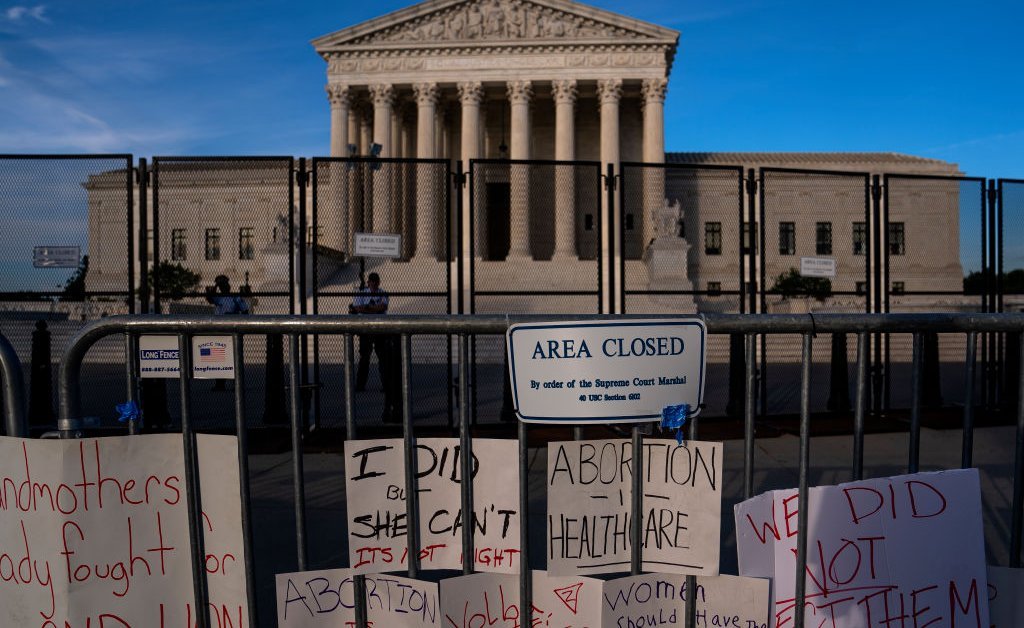
Consultants worry these numbers are solely getting worse now Roe v. calf was repealed, eradicating the constitutional proper to abortion and triggering a sequence of state-level prohibitions that place limits on reproductive well being care.
“Even low-risk being pregnant and childbirth poses a better danger for a mom than abortion,” says Michelle Drew, a household nurse and midwife who’s government director of the Ubuntu Black Household Wellness Collective, a Delaware-based nonprofit. When you think about “pressured being pregnant and compelled childbirth with a being pregnant that might not be timed, might not be desired, or could also be excessive danger,” says Drew, the stakes solely get larger.
A 2021 research estimated that if the U.S. banned abortion outright, the full variety of pregnancy-related deaths would improve by greater than 20% in subsequent years, with a 33% improve amongst black girls. This estimate isn’t correct to the current day, as abortion is predicted to stay accessible even with out abortion in about half of US states roe. However analysis clearly signifies that when entry to abortion will increase, maternal mortality decreases – and vice versa.
Nevertheless, within the US, the impression varies considerably between inhabitants teams. After abortion was legalized within the US, the Supreme Court docket culminated within the authentic Roe v. calf choice in 1973, maternal mortality amongst black girls within the US fell by greater than 30%, whereas there was solely a restricted impact amongst white girls, in response to a research revealed upfront final 12 months. Nearly the entire decline was because of fewer abortion-related deaths amongst girls of shade, says co-author Lauren Hoehn-Velasco, an assistant professor of economics at Georgia State College — suggesting that earlier than abortion was largely authorized within the US, many resorted to girls of shade resort to unsafe strategies of terminating an undesirable being pregnant.
“I do not know if we will say precisely how issues are going to be sooner or later,” Hoehn-Velasco says, noting that advances like abortion tablets can now assist guarantee secure entry, even in states that enable abortions are forbidden.
Even with advances comparable to medical abortion, there may be nonetheless a hyperlink between entry to abortion and maternal mortality within the US. As of 2017, states with restrictive abortion insurance policies had charges of 28.5 deaths per 100,000 births, in contrast with a mean fee of 15.7 in states that defend entry to abortion, in response to a 2021 research revealed within the Journal grew to become contraception. A separate research from the identical 12 months revealed within the American Journal of Public Well being, discovered an identical pattern: states with important restrictions on abortion remedy noticed a 7% improve in all-cause maternal mortality from 2015 to 2018.
There are a variety of doable causes for this dynamic. States with strict abortion insurance policies are additionally usually those who have not expanded Medicaid and have fewer working towards medical professionals, which might make it tougher for folks to entry good well being care. “By the way in which, these are additionally states which have a number of households dwelling in poverty, and lots of people of shade who earn low wages,” says Drew.
Socioeconomic elements comparable to these are intently associated to danger elements comparable to B. Pre-existing medical situations and inadequate entry to prenatal care that improve the chance of being pregnant issues. A 2020 report by well being insurer Blue Cross Blue Defend discovered that charges of being pregnant and childbirth issues amongst commercially insured girls in the US elevated from 2014 to 2018, partly as a result of extra folks with pre-existing well being situations entered being pregnant. The report additionally discovered {that a} third of ladies had fewer than the 10 really helpful prenatal medical appointments throughout being pregnant — and of those that did not, practically 1 / 4 had start issues.
dr Mark Hoofnagle, a trauma surgeon at Washington College Faculty of Medication in St. Louis and co-author of contraception Examine, notes that abortion clinics usually supply many types of reproductive well being care, so insurance policies that make it tough for these services to outlive can have trickle-down results. “Deliberate Parenthood does much more than simply abortions,” says Hoofnagle. “If you happen to assault the clinics basically, you’re exacerbating an current injustice.”
The overwhelming majority of people that endure being pregnant should not have any life-threatening issues; In 2020, there have been 861 maternal deaths and roughly 3.6 million births in the US. However particularly for individuals who come into being pregnant with pre-existing well being situations, “carrying a being pregnant on this nation is a lot riskier than having an abortion,” says Dovile Vilda, a analysis assistant professor who research maternal and human well being at Tulane College Faculty kids of Public Well being and Tropical Medication and co-authored the American Journal of Public Well being to be taught. With out roeand since many individuals can’t journey overseas to have an abortion, extra folks “will probably be pressured to hold undesirable and high-risk pregnancies even when their well being and life are in danger,” she says.
The dangers of this example are usually not hypothetical. For a 2015 research, researchers tracked a gaggle of about 850 girls who requested an abortion at US services. Some had been turned away as a result of they had been previous the gestational age of their states, which ranged from as little as 10 weeks to greater than 20 weeks gestation. About 6% of those that had been denied abortions and gave start reported a doubtlessly life-threatening complication comparable to hemorrhage or eclampsia, in comparison with about 1% of those that had an abortion near their state’s gestational age restrict and about 0.4 % of those that had a primary trimester abortion had. A girl died after being turned away from an abortion clinic and giving start.
At this level, Vilda says, the analysis is obvious: Making abortions tougher means extra girls and infants will get sick and die. “We now have sufficient information and we’ve got sufficient analysis and we’ve got sufficient proof,” she says. “What we actually want now could be political will.”
Extra must-read tales from TIME
[ad_2]


Discussion about this post